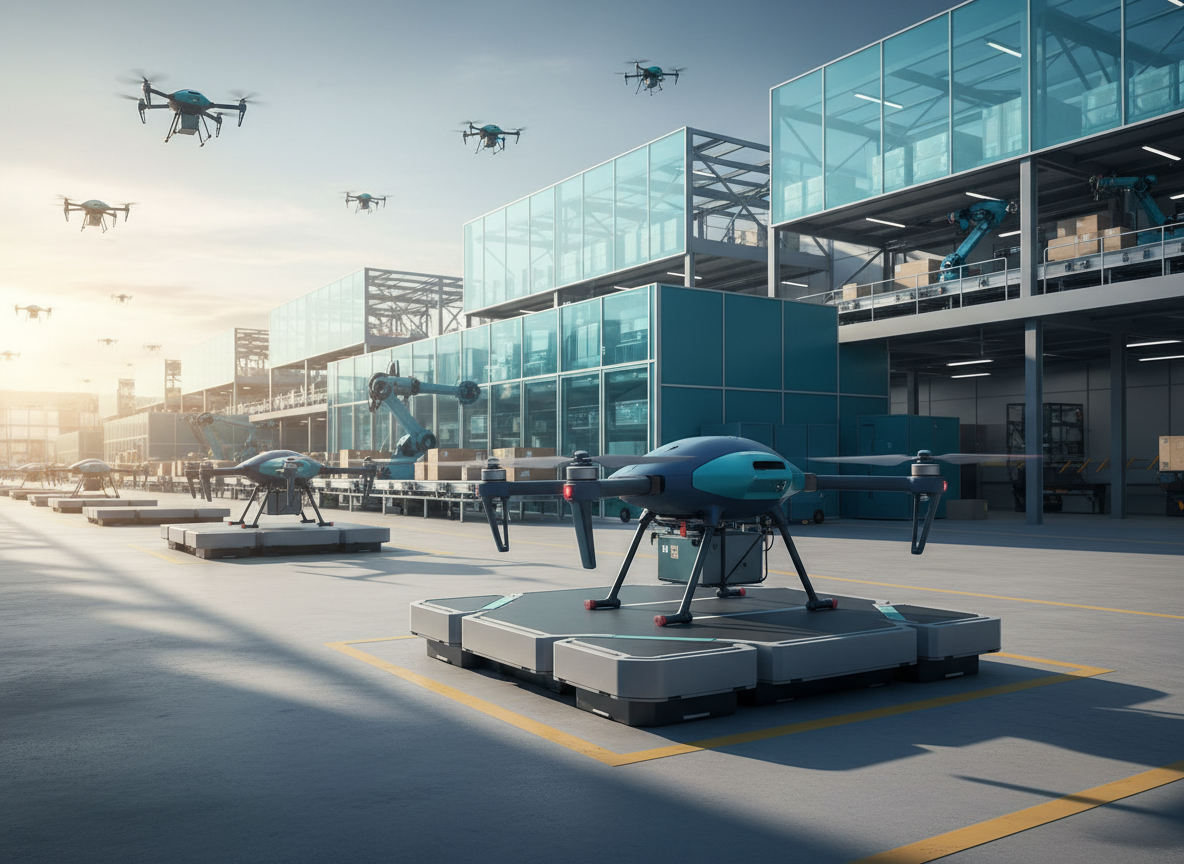
UAV package delivery uses unmanned aircraft systems to move goods between fulfillment points and customers or operational destinations. The category spans retail delivery, healthcare logistics, food delivery, industrial supply and time-sensitive transport.
How a drone delivery network works
A commercial network combines aircraft, payload handling, launch and recovery infrastructure, fleet management, communications, airspace integration and ground operations. The aircraft is only one component of the delivery system.
What determines commercial viability?
- Payload weight and package dimensions
- Range and usable flight time
- Fleet utilization and turnaround time
- Weather tolerance and reliability
- Airspace and regulatory permissions
- Ground infrastructure and fulfillment integration
- Cost per completed delivery
Retailer or restaurant planning a pilot? Store operations, checkout eligibility, package preparation, dispatch integration, customer drop-point selection and backup delivery matter as much as aircraft range. Use our 2026 merchant drone-delivery integration checklist →
Evaluating a system purchase or pilot? See our 2026 commercial drone delivery systems procurement checklist for requirements spanning aircraft, charging and receiving sites, software, FAA authority, service reliability and total cost per completed delivery.
Vendor evaluation resource: If you are comparing drone packages rather than researching a single delivery operator, use the complete UAV system RFQ template and 100-point evaluation matrix to document aircraft, payload, software, infrastructure, training and support requirements.
Choose a delivery model before choosing a drone
A retailer comparing short-radius customer delivery should not use the same qualification criteria as a hospital moving specimens or an offshore operator transporting spares. Start with an operational scenario, then ask vendors for evidence rather than advertised maximum specifications.
- Retail and food: basket eligibility, store integration, pickup workflow, safe customer handoff and cost per accepted order. Use our merchant-integration guide and cost-per-order worksheet.
- Healthcare: specimen integrity, documented custody, system integration, loading constraints and exception handling. See the hospital logistics RFP guide.
- Field-service parts: time-to-repair, technician handoff, parts inventory and dispatch interoperability. See our field-service analysis.
- Offshore and industrial: extended-range BVLOS authority, wind and sea conditions, satellite command links, offshore receiving interfaces and inspection-quality evidence. See the 2026 Section 927 offshore buyer checklist.
Five documents to request in a delivery-system RFP
- Concept of operations: intended routes, roles, airspace, launch sites, turnaround and emergency procedures.
- Permission matrix: operator certificates, waivers, airspace approvals, environmental or local siting requirements, and gaps before go-live.
- End-to-end demonstration record: accepted versus attempted flights, payload qualification, weather exclusions, communication continuity and proof of delivery.
- Integration and data specification: merchant/clinical/industrial system interfaces, order events, custody records, security controls and failure recovery.
- Commercial acceptance schedule: uptime and delivery KPIs, operator responsibilities, training, spares, insurance, incident response and cost per completed mission.
The FAA’s package-delivery guidance distinguishes air-carrier and BVLOS authority from a drone vendor’s hardware capability. Our U.S. delivery tracker separately labels operating markets and announced expansion. A pilot should never be counted as full production capacity based solely on a press release.
Planning real delivery coverage? Nominal aircraft range is not address-level serviceability. Our 2026 drone delivery service-area and drop-zone eligibility guide shows how to validate authorized routes, receiving geometry, checkout restrictions, rejection reasons and a vendor coverage funnel before committing to a launch.
Scheduled B2B drone cargo: fixed-route logistics
November 24, 2026: Volatus Aerospace announced a signed logistics service contract connecting two locations of an unnamed North American logistics customer. The planned Canary deployment supports a stated 5 kg payload, up to 30 km distance and up to six round trips per operating day, with remote operations managed from Vaughan, Ontario. The customer, route location, operating start date and financial terms were not disclosed; a contract announcement is not evidence that the route is already operating.
Unlike on-demand doorstep delivery, a scheduled shuttle needs a repeatable cargo manifest, load and receipt verification, departure slots, a validated route and return-leg plan, recovery capacity and ground transport backup. Ask providers for route-specific authorizations, useful payload at the contracted distance and records of accepted shipments delivered on time. Compare cost per completed shipment or kilogram, not merely cost per flight. See the drone delivery cost worksheet and service-level contract checklist.
Industrial cargo drones for construction and rooftop logistics
Bentley Motors’ November 23 announcement, reported November 25, describes a completed rooftop solar project at its Crewe manufacturing campus using cargo drones to lift 2,030 panels weighing approximately 30 kg each. This is a site-specific industrial lifting application, not a consumer parcel-delivery network. Bentley reported reduced installation time relative to conventional methods; independently comparable cost and safety statistics were not provided.
Procurement teams evaluating a similar service should request a site-specific safety and permissions assessment, evidence of approved load-handling equipment, contractor insurance, roof-load and receiving-area approval, and a schedule with weather contingencies. Compare cost per accepted panel or load placed, including ground handling, interruptions, inspection and fallback lifting arrangements. Use the UAV system RFQ template and insurance and liability checklist.
Where the market is heading
The long-term opportunity is broader than replacing a delivery van for individual trips. Autonomous aerial logistics can become another transportation layer connected to existing fulfillment networks, with aircraft selected according to payload, distance, urgency and operating environment.
Choosing a drone-delivery partner? The 2026 Wing vs. Zipline comparison evaluates current order eligibility, merchant integration, operating approvals, network readiness and fully loaded cost per completed delivery.
Contracting for service reliability? Our 2026 drone-delivery SLA template defines accepted-order completion, on-time performance, cancellation exclusions, fallback delivery and 30-day pilot acceptance tests. Use it alongside the cost-per-order worksheet when evaluating operators.